
Blog
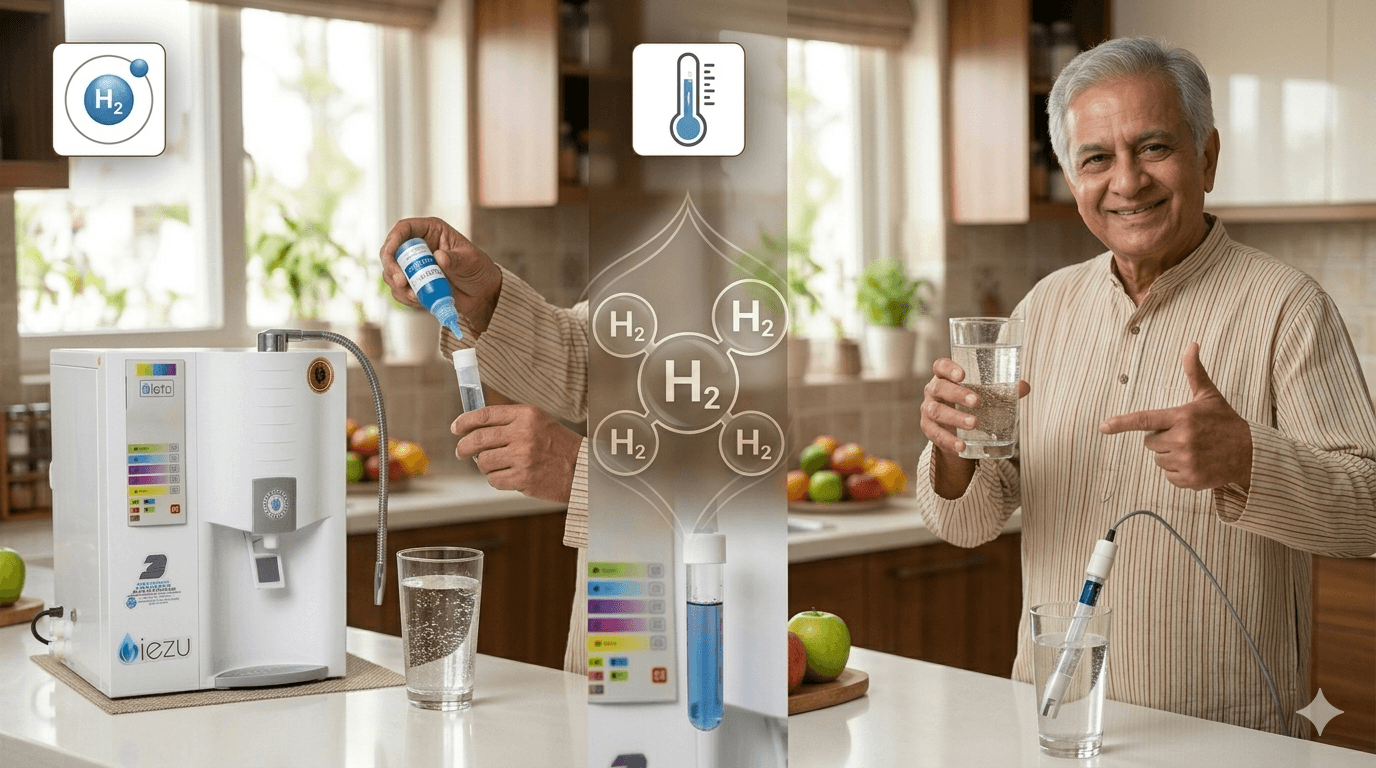
How to Test Hydrogen Water from Your Ionizer at Home (India Edition)
- Posted By
-
 Miezu Water Expert
- On
- No Comments
- Uncategorized

Table of Contents
Table of Contents
Introduction on How to Test Hydrogen Water
Hydrogen-rich water has become one of the most talked-about features in premium water ionizers – especially in India’s growing wellness and alkaline water segment. From claims like “up to 1500 ppb molecular hydrogen” to promises of superior antioxidant potential (ORP), every brand seems to be selling the same futuristic idea: “More hydrogen equals better health.”
But here’s the problem no one talks about: How do you actually verify that your ionizer is really producing hydrogen-rich water at home?
Most ionizer brands in India talk endlessly about hydrogen generation, but almost none show users how to test it. If you’re spending ₹40,000-₹1,50,000+ on a machine, you should know if you’re really getting ionized hydrogen water – or just filtered water in disguise.
This blog is a step-by-step testing guide for Indian users – using affordable, easily available tools to measure H₂ ppm, ORP, and basic output quality from any ionizer brand.
1. What Is Hydrogen Water – And Why Should You Test Hydrogen Water?
Hydrogen water (or H₂-rich water) is ordinary water infused with dissolved molecular hydrogen gas (H₂).
The claimed benefits include:
- Anti-inflammatory properties
- Antioxidant support (reduces oxidative stress)
- Improved recovery & metabolic boost
- Potential cognitive and cellular benefits
But here’s the science-backed catch: These benefits only occur when the hydrogen concentration (H₂ ppm) is high enough – typically 0.5 ppm and above.
So if your ionizer claims to produce 1.0-1.5 ppm, but actually produces 0.1-0.2 ppm, you’re not getting what you paid for. If you can’t verify hydrogen ppm, you’re trusting marketing – not chemistry.
2. Home Testing Methods for Hydrogen Water in India
There are 3 reliable ways to test hydrogen water at home:
| Method | Tool Needed | Accuracy |
|---|---|---|
| Reagent Testing (Drops) | H₂ Test Reagent Kit | Accurate enough for home use |
| Digital H₂ Meter | Hydrogen PPM Meter (USB or Pen) | Highly accurate |
| ORP Meter | ORP Pen (mV) | Indirect but reliable reading |
Each of these is available on Amazon India or via specialty water testing suppliers.
Method 1: Hydrogen Reagent Drops Test (Beginner-Friendly)
What you need:
- H₂ reagent powder/drops kit (e.g., H2Blue or Japanese H₂ Drops)
- Glass vial or shot glass
- Freshly dispensed ionized water
How it works: The reagent reacts with dissolved hydrogen. Each drop equals 0.1 ppm of H₂.
Step-by-Step:
- Fill test vial with 6-8 ml of freshly ionized alkaline water
- Add one drop at a time of reagent
- Swirl gently after each drop
- Count drops until the blue color disappears
> Important: Test within 30 seconds of collecting water – hydrogen escapes fast.
Best Use Case: For users who want quick, visual testing. Only measures 0-2.0 ppm range.
Method 2: Digital Hydrogen PPM Meter (Most Accurate at Home)
What you need:
- A digital portable H₂ PPM meter (e.g., Trustlex ENH-1000, H2 Dolphin, or EXTECH)
- A clean beaker or glass
How it works: The meter uses electrochemical sensing to detect dissolved hydrogen directly – giving accurate ppm value.
Testing Steps:
- Turn on the device and calibrate (if required)
- Immerse the sensor probe in fresh ionized water
- Wait 15-45 seconds for stabilized reading
- Note the ppm result (e.g., 0.8 ppm, 1.3 ppm, etc.)
Ideal for advanced consumers, labs, or reviewers. Reliable for long-term reference.
Method 3: ORP Meter (Indirect Testing)
What you need:
- ORP Digital Pen (redox tester)
- Fresh ionized water sample
How it works: Measures the Oxidation Reduction Potential (mV) – not hydrogen directly. ORP of -200 to -400 mV generally indicates good hydrogen presence.
Testing Instructions:
- Pour alkaline water into glass
- Insert ORP probe
- Wait until reading stabilizes
- Ideal result: -200 to -450 mV
Cannot replace ppm measurement, but highly useful in early-stage validation.
3. Testing Tips for Indian Users (Hard Water, TDS, Storage, Climate)
Hydrogen testing is not the same in Japan, the U.S., and India – because:
- Indian homes often use tank or borewell water
- TDS levels in India vary from 80 to 2,000 ppm
- Hot climate speeds up hydrogen gas dissipation
- pH and mineral levels affect hydrogen retention
Test Immediately After Dispensing
Hydrogen escapes water within minutes. Test within 30 seconds. Never store water first – freezer or fridge won’t help.
If You’re Using RO Before Your Ionizer
RO water holds hydrogen longer, but low mineral content can reduce ionization efficiency. A re-mineralization filter or cartridge is ideal.
Warm vs. Cold Climate
Hot kitchens = faster hydrogen loss. Cooler glass or stainless steel = slower dissipation. Use chilled container for slightly extended ppm testing time.
4. What Hydrogen Levels Should Your Ionizer Produce?
Here’s a reliable range for high-grade hydrogen ionizer output in India:
| Output Mode | Recommended pH | Expected H₂ (ppm) |
|---|---|---|
| Drinking Mode 1 | pH 8.5 | 0.5-0.8 ppm |
| Drinking Mode 2 | pH 9.0 | 0.8-1.2 ppm |
| Strong Alkaline | pH 9.5+ | 1.2-1.6 ppm |
If your ionizer is producing less than 0.3 ppm hydrogen at the highest alkaline setting, it is not a true hydrogen ionizer – it’s just a filter + pH booster.
5. What If Your Hydrogen Levels Are Low?
Check these factors in order:
- Is your input water filtered but not over-purified? (ideal TDS: 50-150 ppm)
- Have you cleaned your electrolysis plates recently?
- Are you collecting from the alkaline outlet, not the filtered/acidic outlet?
- Is the ionizer in high output mode, not neutral drinking water?
- Has the filter exceeded its lifecycle? (old carbon reduces hydrogen bonding)
If you’ve checked all and still see low ppm, the ionizer may have weak electrolysis power, fake hydrogen claims, plate scaling from hard water, or a faulty internal chamber design.
Always demand proof of hydrogen output before buying a unit in India.
6. Quick Hydrogen Testing Checklist
- Use fresh water straight from the ionizer
- Test within 15-45 seconds
- Use reagent drops or H₂ meter
- Note ppm reading and compare to brand claim
- Keep TDS and input filter condition in mind
- Re-test after internal cleaning or filter change
7. Conclusion
Testing hydrogen water from your ionizer at home is not complicated – it just requires the right tools and a little awareness.
In a market full of over-claimed specs and hype-driven advertising, the ability to verify hydrogen ppm and ORP puts the power back in the consumer’s hands. You don’t have to trust what’s printed on the box. You can test it yourself – quickly, affordably, and accurately.
What separates a true hydrogen ionizer from a basic alkaline filter is not the pH alone, but its ability to consistently produce measurable hydrogen levels over time. Making testing a habit ensures you’re not only drinking alkaline water – you’re drinking functional water backed by science, not guesswork.