
Blog
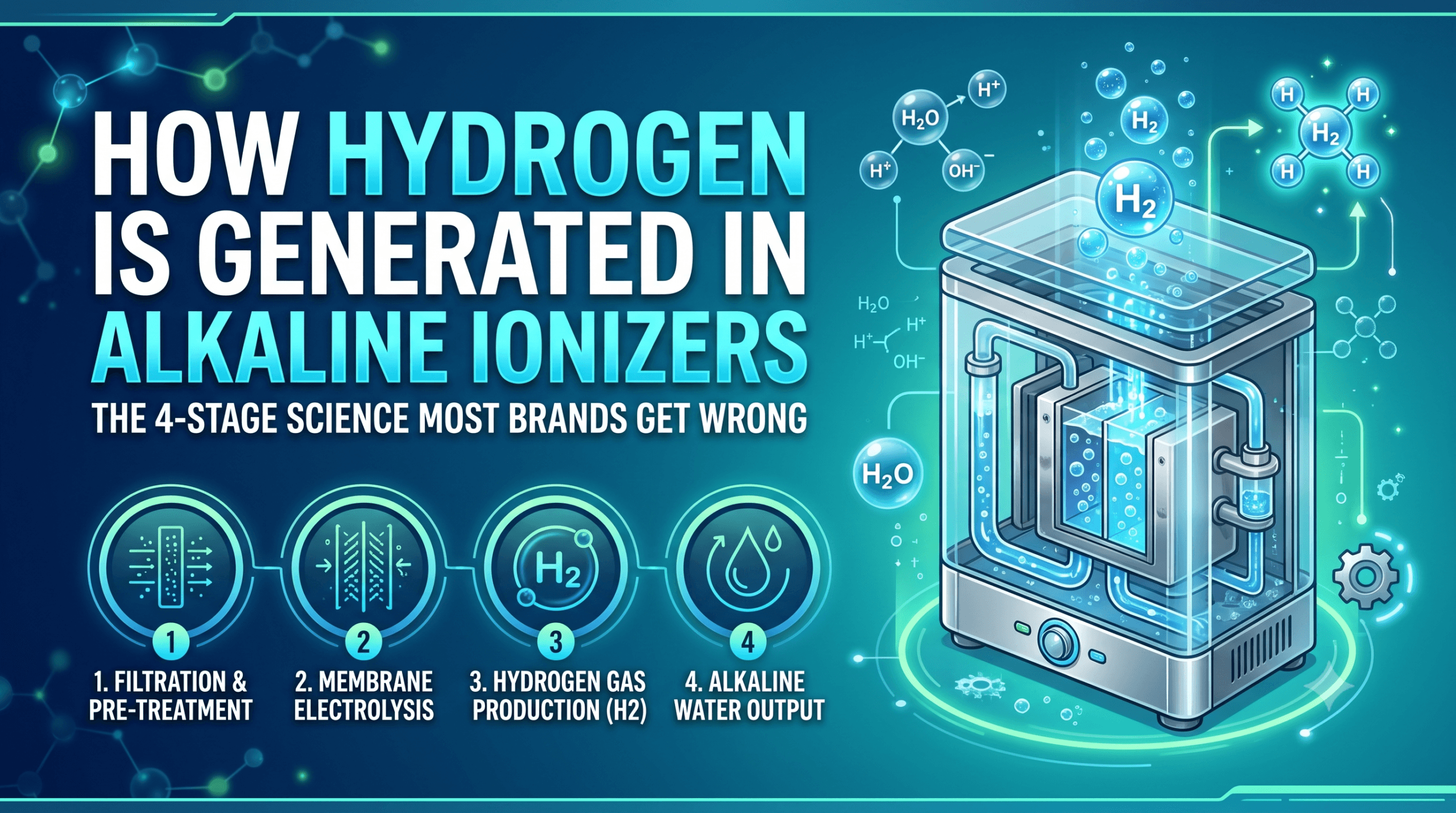

There is a strange gap in how alkaline water is sold in India. Brands talk endlessly about pH. They talk about ORP. Many talk about microclustered or restructured water, which sounds impressive and is not supported by evidence.
What they mostly do not talk about, or talk about only vaguely, is dissolved molecular hydrogen. Which is unfortunate, because according to the peer-reviewed literature, molecular hydrogen is the thing that actually matters.
This article explains how hydrogen is generated in alkaline ionizers, stage by stage, using the actual electrochemistry. It also identifies which popular marketing claims the research has examined and refuted, because you cannot evaluate a ₹1.5 lakh appliance if the vocabulary being used to sell it to you is unreliable.
Why Hydrogen, and Not pH, Is the Real Story
Let us start with the finding that should reframe how you read every alkaline ionizers advertisement you see from now on.
A comprehensive review of electrolyzed-reduced water, published in the peer-reviewed literature, systematically examined the various properties that had been credited with producing the observed effects of ionized water. The candidates included alkaline pH, negative ORP, altered water structure, microclusters, free electrons, active hydrogen, and mineral hydrides.
One by one, these propositions were tested and refuted. The review concluded that molecular hydrogen, H2, is the exclusive agent responsible for both the negative ORP and the observed therapeutic effects of electrolyzed-reduced water. It further noted that the pseudoscientific marketing surrounding concepts like microclustering had actively damaged mainstream scientific acceptance of the category.
That is a remarkable and clarifying finding, and it cuts in two directions at once. It means that a great deal of what you are told about ionized water is not true. And it means that there is a real, evidence-backed mechanism underneath, which is dissolved molecular hydrogen.
The scientific interest in H2 itself is substantial. A landmark 2007 paper in Nature Medicine, from the laboratory of Dr. Shigeo Ohta, found that molecular hydrogen acts as a therapeutic antioxidant by selectively reducing cytotoxic oxygen radicals. Since then the research base has expanded to encompass a large body of published studies and clinical trials.
What makes H2 interesting to researchers is its selectivity. Unlike broad-spectrum antioxidants, molecular hydrogen appears to preferentially target the most damaging reactive oxygen species, such as hydroxyl radicals, while leaving beneficial reactive oxygen species that serve as cell signalling molecules largely alone. It is also the smallest molecule in existence, which allows it to diffuse readily across cell membranes.
So the question of how hydrogen is generated in alkaline ionizers is not a technical footnote. It is the central question about whether the machine does what it claims.
Stage 1: Filtration, Before Any Chemistry Happens
Nothing useful happens if you start with dirty water.
Every credible alkaline ionizers filters incoming water before it reaches the electrolysis chamber. A sediment stage removes physical particulates. An activated carbon stage removes chlorine, chloramines, and organic compounds. Systems built for challenging water add ultrafiltration, RO membranes, or UV treatment.
There are two reasons this stage exists and both matter. The first is obvious: you do not want to drink contaminants. The second is less obvious but structurally important: sediment and chlorine damage electrode plates and accelerate scale formation, which degrades the machine’s ability to generate hydrogen over time. Filtration protects the chemistry as much as it protects you.
Crucially, filtration must not strip out the dissolved minerals entirely. This is the point people miss when they assume RO water is the ideal input to alkline ionizers. It is not, and the next stage explains why.
Stage 2: Electrolysis, Where the Hydrogen Is Actually Made
The filtered water now enters the electrolysis chamber, which contains an array of platinum-coated titanium plates separated by an ion-exchange membrane. Some plates are wired as cathodes with a negative charge, others as anodes with a positive charge. A low-voltage direct current is applied.
Here is what physically happens, and it is worth being precise because this is where the marketing usually turns to fog.
At the cathode, the negatively charged plate, water molecules gain electrons. This reaction produces hydrogen gas and hydroxide ions. The hydrogen gas, H2, dissolves into the surrounding water. The hydroxide ions, OH minus, raise the pH of that stream, making it alkaline. Positively charged mineral ions in the water, principally calcium, magnesium, and potassium, are electrostatically attracted toward the cathode and concentrate in this stream.
A common misconception is that hydrogen is added to the water from an external source. In reality, the hydrogen is generated inside the electrolysis chamber itself. As electric current passes through the water, some water molecules are split at the cathode, producing molecular hydrogen (H₂), which immediately dissolves into the surrounding water.
At the anode, the positively charged plate, the opposite occurs. Water loses electrons, producing oxygen and hydrogen ions, and the stream becomes acidic. Negatively charged ions such as chloride and sulphate migrate toward it.
| Cathode | Anode |
|---|---|
| 2H₂O + 2e⁻ yields H₂ + 2OH⁻ | 2H₂O yields O₂ + 4H⁺ + 4e⁻ |
The ion-exchange membrane keeps these two streams physically separate while allowing ions to pass through, so that they can be drawn off through different outlets. The alkaline stream, hydrogen-rich and mineral-concentrated, is what you drink. The acidic stream is genuinely useful for cleaning, washing vegetables, and skincare.
And here is the critical dependency: this reaction needs dissolved minerals to carry the current. Water with insufficient mineral content conducts poorly, and electrolysis becomes weak or ineffective. This is precisely why feeding heavily demineralised RO water directly into an ionizer produces disappointing results, and why remineralisation between purification and ionization matters in high-TDS Indian homes. Integrated systems like the Miezu AURA handle this sequence internally, purifying, and then ionizing.
Why Minerals Matter
Electrolysis depends on electrical conductivity, and in water that conductivity comes primarily from dissolved minerals such as calcium, magnesium, sodium, and potassium. These ions carry electric current through the water, allowing the electrochemical reactions at the electrodes to proceed efficiently.
Imagine two glasses of water. One contains distilled water with almost no dissolved minerals. The other contains properly mineralised drinking water. When the same electrical current is applied, the mineralised water conducts electricity far more effectively, producing stronger electrolysis and greater dissolved hydrogen. Distilled or heavily demineralised water, by contrast, conducts poorly, resulting in weaker hydrogen generation.
This is why water chemistry matters just as much as the alkaline ionizers itself. A high-quality electrolysis chamber cannot reach its full potential if the incoming water lacks the mineral content needed for efficient electrolysis.
Stage 3: Why the Plates Determine How Much Hydrogen You Get
The quantity of dissolved hydrogen alkaline ionizers produces is not a fixed property of the technology. It is a function of the electrolysis chamber’s engineering.
Total plate surface area is one of the most important factors influencing hydrogen production. More surface area provides more locations where the electrochemical reaction can occur, which is why both plate count and overall electrolysis chamber design matter. Plate geometry, including factors such as plate size, spacing, and surface engineering, also affects the effective reaction area and overall electrolysis efficiency.
Platinum coating quality is the second variable. Platinum is the catalyst that makes this reaction efficient at low voltage, and a thicker, better-adhered coating sustains that catalytic efficiency for years. As the coating wears, hydrogen output falls.
Scale is the third. Mineral deposits on the plates physically insulate the platinum from the water, and in hard-water India this is the primary cause of declining hydrogen output over time. Automatic polarity reversal, which periodically flips the charge to lift scale off the plates, is not an optional convenience in Indian conditions. It is what preserves the machine’s ability to make hydrogen at all in year five.
Miezu’s alkaline ionizers use platinum-coated titanium plates across all five models, with five-plate configurations in CORE, NEO and AURA and nine-plate configurations in VITA and SUPREME, giving families a genuine choice about how much electrolysis surface area they want.
Stage 4: Getting the Hydrogen Into You, Which Is Harder Than It Sounds
This is the stage nobody advertises, and it is the one that should most influence how you use your machine.
Molecular hydrogen is the smallest molecule in existence. It is also a gas, and it does not stay dissolved in water indefinitely. It escapes to the atmosphere, and it does so reasonably quickly. Research measuring hydrogen-rich water has found that dissolved H2 concentrations decline over time after production, with the ORP correspondingly rising toward zero as the hydrogen leaves.
The practical implications are direct and worth internalising.
- Drink ionized water fresh. Its most valuable property is the one that dissipates fastest.
- Do not store it for days in an open container expecting the hydrogen to still be there.
- This is also the honest structural reason bottled alkaline water is a fundamentally different product. Whatever pH is printed on the label, the dissolved hydrogen has largely left the building long before the bottle reaches you.
A point-of-use alkaline ionizers produces hydrogen-rich water on demand, in your kitchen, seconds before you drink it. That is not a marketing advantage, it is a physical one, and it is arguably the strongest single argument for owning a machine rather than buying bottles.
The Claims You Should Ignore
Because the research is unusually clear here, you can hold brands to a higher standard than most consumers realise. The following claims have been examined in the literature and found wanting.
- Microclustered or restructured water. The idea that ionization reorganises water into smaller molecular clusters that hydrate more efficiently is not supported. It was one of the specific propositions the electrolyzed-reduced water review examined and refuted.
- Free electrons in the water. Negative ORP is caused by dissolved hydrogen gas, not by free electrons floating in your glass.
- Active or atomic hydrogen. Atomic hydrogen is a highly reactive free radical that would combine with itself almost instantly. Researchers looked for it in ionized water and could not find it.
If a brand’s central pitch rests on any of these three, you have learned something useful about how carefully it engages with evidence. The claims worth taking seriously are the measurable ones: pH, ORP, and dissolved hydrogen concentration.
What to Actually Ask a Manufacturer
Knowing how hydrogen is generated in alkaline ionizers gives you a genuinely better set of questions than most buyers walk in with.
- What is the dissolved hydrogen output, in ppm or ppb, not just the ORP?
- What is the total electrolysis surface area in the alkaline ionizers, and what plate geometry is used?
- 9 Amazing Hydration Benefits That Can Transform Your Health Naturally How thick is the platinum coating, and how does the machine prevent scale from insulating it?
- How does the system handle my source water TDS, given that electrolysis requires minerals to work?
A manufacturer engineering its own electrolysis chambers can answer these. Miezu’s alkaline ionizers are developed in collaboration with CSIR-IICT, the Indian Institute of Chemical Technology under the Council of Scientific and Industrial Research, Ministry of Science and Technology, Government of India, and the range spans five models from ₹98,499 to ₹2,04,999 with a ten-year warranty. If you want the electrolysis configuration matched to your home’s actual mineral content, a free water consultation with a TDS test is the sensible first step, because as this article has hopefully made clear, the chemistry begins with what is already in your water.
Frequently Asked Questions
How is hydrogen generated in alkaline ionizers?
Through electrolysis. A low-voltage direct current is applied across platinum-coated titanium plates in a chamber containing filtered water. At the negatively charged cathode, water molecules gain electrons, producing hydrogen gas which dissolves into the water, and hydroxide ions which raise the pH. This hydrogen-rich alkaline stream is separated from the acidic stream by an ion-exchange membrane.
Is dissolved hydrogen the same as negative ORP?
They are closely related but not identical. Negative ORP in ionized water is caused by dissolved molecular hydrogen. However, ORP is a combined measure of the water’s antioxidant character, not a direct measurement of hydrogen concentration in ppm. Two machines can show similar ORP with different actual hydrogen levels.
Does alkaline ionizers lose its hydrogen over time?
Yes. Molecular hydrogen is a gas and escapes from water to the atmosphere over time, with ORP rising toward zero as it does. This is why ionized water should be consumed fresh, and it is the fundamental reason a point-of-use ionizer differs from bottled alkaline water.
Can alkaline ionizers make hydrogen water from RO water?
Poorly, unless the water is remineralised first. Electrolysis requires dissolved minerals to conduct current, and heavily demineralised RO water conducts badly. This is why integrated systems purify, then remineralise, then ionize, as the Miezu AURA does.
How much dissolved hydrogen should good alkaline ionizers produce?
Quality alkaline ionizers produce dissolved hydrogen measurable in ppm, with output depending on plate surface area, platinum coating quality, source water mineral content, and the pH setting selected. Ask manufacturers for the dissolved hydrogen figure specifically rather than accepting ORP as a proxy.
Does a higher pH mean more dissolved hydrogen?
Not necessarily. Although higher pH settings often coincide with increased electrolysis, pH and dissolved hydrogen are not the same thing. The amount of molecular hydrogen produced depends on several factors, including the efficiency of the electrolysis chamber, plate surface area and platinum coating, electrical current, water flow rate, and the mineral content of the source water. Two alkaline ionizers operating at the same pH can produce different dissolved hydrogen concentrations depending on their engineering and the water being used. For this reason, ask manufacturers for measured dissolved hydrogen output (in ppm or ppb) rather than relying on pH alone.