
Blog
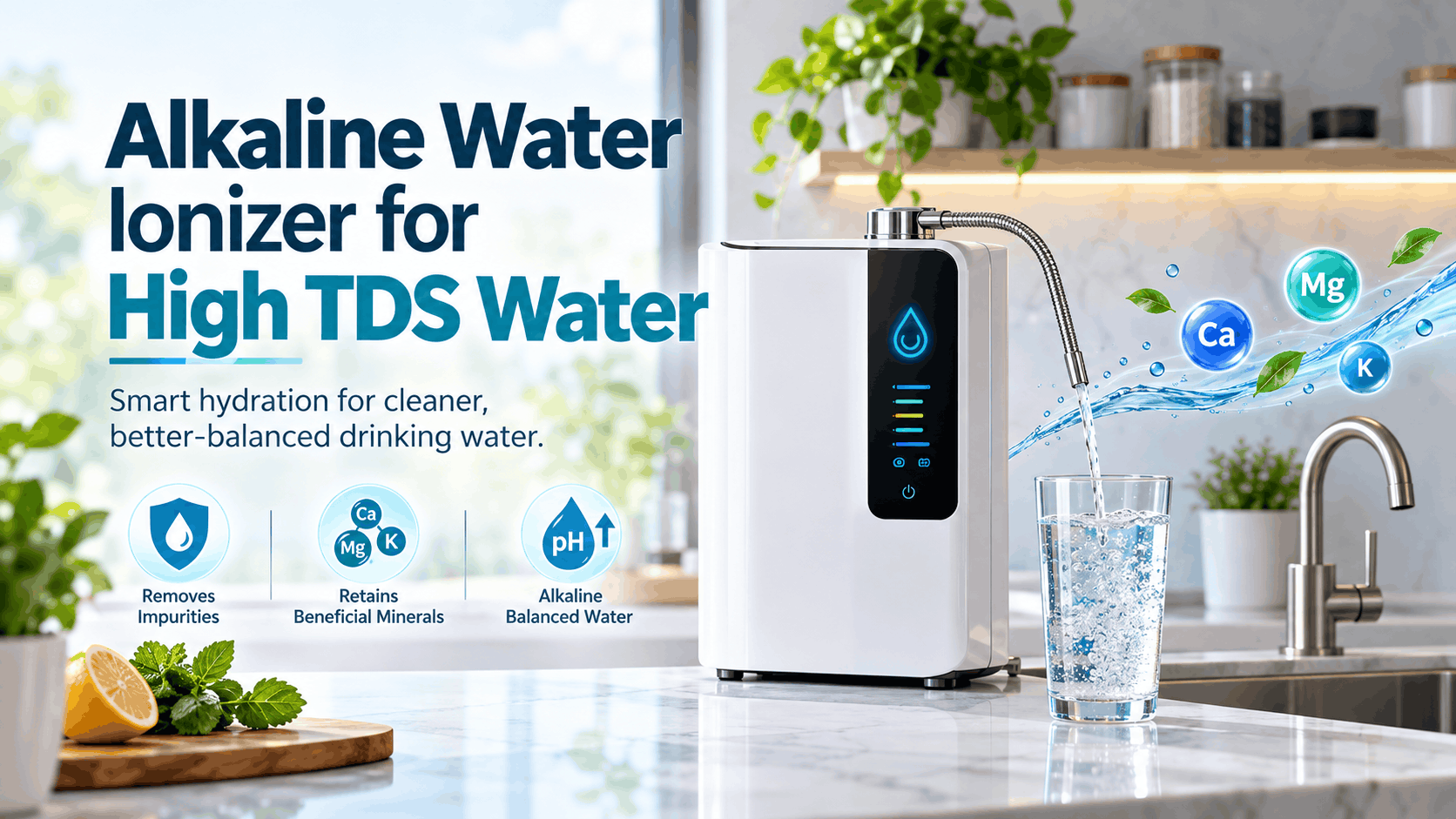
Alkaline Water Ionizer for High TDS Water
- Posted By
-
 Water Expert Miezu
- On
- Product Knowledge & Support

Table of Contents
If your home receives high-TDS water from a borewell, tanker or another source, choosing an alkaline water ionizer requires more than comparing plate counts or pH settings. You first need to understand whether your water requires purification and whether the ionizer can operate with the water it receives.
An alkaline water ionizer uses electrolysis to change water’s pH. Reverse osmosis (RO), by contrast, reduces many dissolved substances through a membrane. These technologies serve different purposes, so a machine that produces alkaline water should not automatically be considered suitable for purifying high-TDS water.
For homeowners dealing with high-TDS drinking water, the practical approach is to assess the source water, select an appropriate purification system and then determine whether an ionizer can be added. The Miezu Core is one option to consider when you already have suitable treated water or plan to install the ionizer after RO purification.
1. What Does High TDS Mean for Your Drinking Water?
TDS stands for total dissolved solids. It measures the combined concentration of dissolved substances, including minerals and salts, in water. Readings are commonly expressed in parts per million (ppm) or milligrams per litre (mg/L).
Water with elevated TDS may have a noticeable taste or contribute to scaling, depending on the substances dissolved in it. However, TDS alone cannot identify individual contaminants or determine whether the water is safe to drink. A water-quality assessment is needed to establish which, if any, treatment is appropriate.
In India, the BIS drinking-water specification lists 500 mg/L as the acceptable limit for TDS (TDS fact sheet) and 2,000 mg/L as the permissible limit when no alternative source is available. The latter should not be interpreted as a target for drinking water or proof that every water source below that level is safe.
The World Health Organization also notes that TDS can affect the acceptability and taste of drinking water, but it has not established a health-based guideline value for TDS itself.
If your water has an unusually high reading, arrange an appropriate water-quality test rather than relying on a handheld TDS meter alone. Depending on the source, testing may need to cover hardness, fluoride, nitrate, metals, salinity and microbiological contamination.
2. Can an Alkaline Water Ionizer Handle High-TDS Water?
Not every alkaline water ionizer is suitable for direct connection to high-TDS water.
An ionizer passes water through an electrolysis chamber containing electrodes. The electrical process changes the characteristics of the water, including its pH. The machine does not automatically remove the dissolved salts and other contaminants that may be present in the incoming water.
High mineral content and hardness can also influence the ionization process and contribute to scale formation, depending on the water chemistry and equipment design.
Before buying an ionizer, establish whether it is intended to connect directly to your supply or needs pre-treatment.
Consider these questions:
- What is the actual TDS of your source water?
- Does the water contain excessive hardness or other contaminants?
- Does the ionizer’s input specification match your water?
- Does the manufacturer recommend an RO purifier before the ionizer?
- Are there specific requirements for water pressure, mineral content or maintenance?
The key point: An alkaline water ionizer changes water chemistry; it should not be used as a substitute for a purification system when contaminant removal is required.
3. Should You Install an RO Purifier Before an Alkaline Water Ionizer?
For high-TDS water, an RO purifier may be an appropriate part of the treatment system. Whether it is necessary depends on the water analysis and the contaminants that need to be addressed.
RO can reduce many dissolved substances, including salts, but the performance of the complete system depends on the membrane, pre-treatment, operating conditions and the quality of the incoming water.
Here is how the main options differ:
| Factor | RO purifier | Alkaline water ionizer | RO purifier with a separate ionizer |
| Primary function | Reduces many dissolved substances | Changes water pH through electrolysis | Combines purification and ionization in sequence |
| High-TDS water | May be suitable when correctly selected for the water conditions | Requires input water within its specified operating limits | Can be suitable when the RO system treats the water adequately and the ionizer receives compatible output |
| Contaminant removal | Depends on the contaminants and treatment design | Not a replacement for purification | Primarily provided by the purification stage |
| Main buying consideration | Treatment performance and water recovery | Input-water compatibility and electrode maintenance | Compatibility between both systems and total ownership cost |
If your existing RO purifier is working properly, adding a compatible ionizer may be worth evaluating. If you need to replace the purifier as well, compare a separate RO-plus-ionizer setup with an integrated system designed for both functions.
Do not assume that every RO purifier produces water suitable for every ionizer. Check the ionizer’s permitted input TDS and other requirements after RO treatment.
4. How to Choose an Alkaline Water Ionizer for High-TDS Water
Before comparing models, evaluate the following features and requirements.
Check the permitted input TDS
This should be one of your first checks. Some ionizers are intended for relatively low-TDS water, while others may have different input requirements.
Ask for the manufacturer’s recommended input range and determine whether it refers to water entering the ionizer directly or water that has already passed through an RO purifier.
Look at electrode material and plate configuration
Plate count is a useful specification, but it should not be the only deciding factor.
Check the electrode material, design, cleaning mechanism and operating conditions. More plates do not automatically guarantee better performance with high-TDS water, and a higher pH setting does not demonstrate superior purification.
Check the cleaning and maintenance requirements
Mineral scale can affect equipment that operates with hard water. Ask how the ionizer manages scale, whether automatic cleaning is included and which maintenance procedures remain necessary.
Also clarify whether the recommended cleaning schedule changes with your water conditions.
Verify output capacity
A model’s stated litres-per-hour capacity can help you assess whether it meets your household’s requirements. Ask how that capacity was measured and under what input-water conditions.
Calculate the complete cost
Include the purchase price, existing or new RO equipment, installation, servicing and any replacement components. An ionizer that works only after additional treatment may require a different overall budget from a direct-connect model.
Not Sure Whether Your Water Is Suitable for an Alkaline Water Ionizer?
Before choosing an alkaline water ionizer, check your source water’s quality and TDS level. If you use borewell or tanker water, consider an appropriate water-quality test to identify any treatment requirements. Then confirm the ionizer’s permitted input-water range with the manufacturer.
Need help choosing the right Miezu model? Contact the Miezu team with your water source (municipal, borewell, tanker or RO-treated water) and available TDS reading. We can help you understand the next steps for assessing compatibility before installation.
5. Consider the Miezu Core 5-Plate Alkaline Water Ionizer
If you already have an RO purifier or another suitable source of treated water, the Miezu Core is worth considering as an alkaline water ionizer for home use.
The Core is a separate ionization unit rather than a built-in RO purifier. Its purpose is to change the pH of compatible input water through electrolysis, so households with high-TDS source water should plan for the necessary purification before installation.
Key features of the Miezu Core
- Five platinum-coated titanium plates: The electrode configuration used for ionization.
- Selectable pH range of 5.5–10.0: Offers different water settings, depending on the selected mode and operating conditions.
- Stated output of 45–50 litres per hour: A capacity to compare with your household’s water requirements.
- Tankless operation: Provides water on demand rather than relying on a built-in storage tank.
- Automatic cleaning system: Helps manage electrode maintenance, although it does not eliminate every servicing requirement.
- Installation options: Countertop or wall-mounted.
- Power consumption: Listed maximum of 220 W.
- Price: ₹98,499 on Miezu’s product page at the time of writing.
- Electrode warranty: A stated ten-year warranty on the electrodes or plates, subject to the applicable terms.
The Core is also listed with a single-touch control panel and five water settings. Before purchasing, confirm the current price, installation arrangements and warranty conditions.
Is the Miezu Core suitable for high-TDS water?
The most important consideration is how the Core will receive its water.
Miezu’s installation guidance recommends connecting the Core directly to tap water at TDS levels up to 280 ppm and installing it after RO when TDS exceeds 280 ppm. Its technical specification separately lists an input TDS range of 150–280 ppm.
Because these figures are not identical, confirm the acceptable input range with Miezu before installation. In particular, ask which specification applies to the water entering the machine after RO treatment.
If your household receives high-TDS borewell or tanker water, do not connect the Core directly to that supply without confirming suitability. Instead, assess the water first and choose an appropriate purification system where necessary.
If you already own a suitable RO purifier, the Core may be worth evaluating as a separate ionization stage. If you need both RO purification and alkaline water ionization in one appliance, compare the Miezu Aura, which combines these functions in a single unit. The Miezu Core, by contrast, is a separate ionization unit intended for compatible input water. Compare the required purification, installation arrangements, maintenance and total ownership cost before choosing between the two.
What should you confirm before buying?
Ask Miezu Alkaline Water Ionizer to clarify the permitted input-water range, the expected output under your water conditions, the recommended maintenance schedule and the exact coverage of the electrode warranty.
You should also confirm whether your current RO purifier is compatible with the Core and whether any additional treatment is needed.
These checks are particularly important when the original source water has high TDS because successful installation depends on the quality of the water entering the ionizer, not just the reading at the source.
6. Common Mistakes to Avoid When Buying an Ionizer for High-TDS Water
Choosing by pH alone
A higher pH does not establish that water is safe or that a machine removes contaminants. Evaluate purification and ionization separately.
Assuming TDS tells you everything
A TDS meter gives a useful preliminary reading, but it does not identify individual contaminants or test microbiological safety. Use appropriate water testing to decide which treatment is required.
Connecting the ionizer directly to untreated water
If the source water exceeds the machine’s permitted input range, direct connection may be unsuitable. Follow the manufacturer’s requirements for pre-treatment and installation.
Ignoring maintenance and scaling
Automatic cleaning can help, but it does not guarantee that the unit will never need servicing. Consider your water hardness and the manufacturer’s maintenance instructions.
Buying without comparing total cost
If your water needs RO treatment, include the purifier and its ongoing costs in your budget. Compare the complete system rather than the ionizer’s price alone.
Final Recommendation
When choosing an alkaline water ionizer for high-TDS water, start with the water itself. Find out what is dissolved in your supply, establish which treatment is needed and check the ionizer’s permitted input conditions.
The Miezu Core can be considered by households that already have suitable treated water or plan to install it after an appropriate RO system. It should not be treated as a standalone solution for removing high TDS.
Before making your decision, confirm input-water compatibility, maintenance requirements and the total cost of the complete setup.
Frequently Asked Questions
Can an alkaline water ionizer reduce TDS?
An alkaline water ionizer is not a substitute for an RO purifier. Ionization changes water chemistry but does not reliably remove the dissolved substances measured by TDS.
What TDS level is suitable for the Miezu Core?
Miezu's product information recommends direct connection for water with TDS up to 280 ppm and post-RO installation above that level. Its technical specification lists an input TDS range of 150–250 ppm, so confirm the exact operating requirement with Miezu before purchasing.
Do I need an RO purifier before buying an alkaline water ionizer?
Not in every situation. The answer depends on your source water, water-quality test results and the ionizer's input requirements. If your water has high TDS or contaminants that require removal, suitable purification may be necessary before ionization.
Is a five-plate ionizer suitable for a family?
Plate count alone cannot determine suitability. Consider the unit's input-water requirements, stated output, maintenance needs and the household's daily demand.
Does alkaline water provide additional health benefits?
Claims that alkaline water prevents disease, detoxifies the body or offers broad health advantages are not established by strong evidence. Choose a water-treatment system based on its verified functionality and your household's water-quality requirements.