
Blog
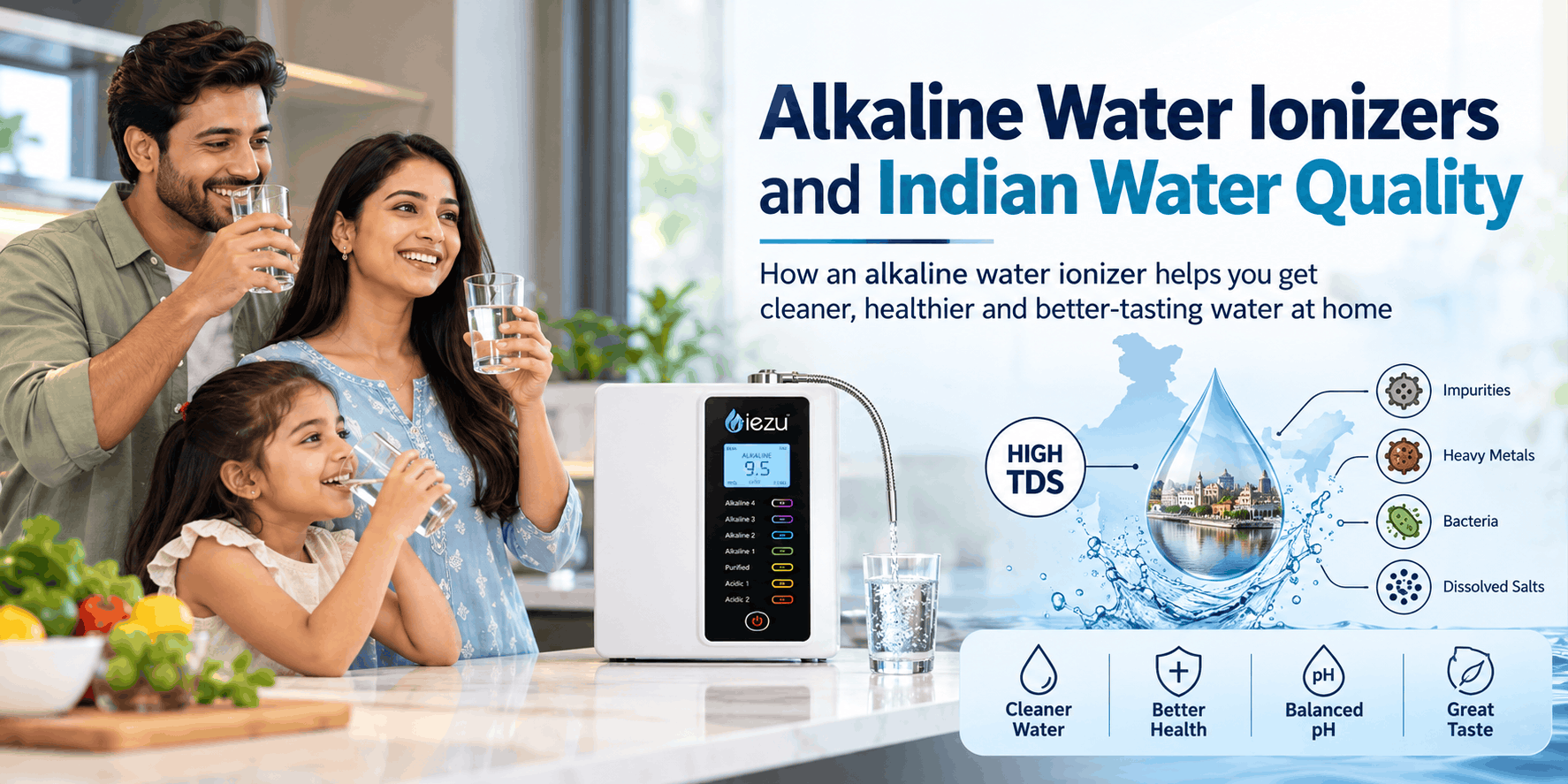
Alkaline Water Ionizers and Indian Water Quality
- Posted By
-
 Water Expert Miezu
- On
- Product Knowledge & Support

Table of Contents
Quick answer: Choosing an alkaline water ionizer in India starts with understanding your household’s water quality. Check TDS, hardness, pH and potential contaminants before selecting a treatment system. An alkaline water ionizer does not automatically purify water or remove harmful contaminants. If your drinking water is already safe and meets the machine’s input requirements, the Miezu Core 5-plate ionizer may be worth considering. Always confirm water compatibility, installation requirements and whether pre-treatment is necessary before purchasing.
Alkaline Water Ionizers and Indian Water Quality: What Homeowners Should Know
The water entering your kitchen can vary considerably depending on where you live and how your home receives its supply. Some households use treated municipal water, while others depend on borewells, tankers or a combination of sources. These differences can affect the type of water treatment your family needs before choosing an alkaline water ionizer.
If you are considering an alkaline water ionizer in India, understanding your household water quality should be the first step. Factors such as total dissolved solids (TDS), hardness, pH and possible contaminants can influence which treatment system is suitable for your home.
An ionizer can be a useful addition to an appropriate drinking-water setup, but it is important to understand what it does—and what it does not do. An alkaline water ionizer is not automatically a water purifier, and a higher pH does not prove that water is safe to drink.
This guide explains how to assess your water, when pre-treatment may be necessary, and how to decide whether the Miezu Core 5-plate alkaline water ionizer is suitable for your household.
Why Indian Water Quality Varies From One Home to Another
There is no single water-quality profile that applies to every Indian household. Even homes in the same city may receive water from different sources or experience different storage and plumbing conditions.
Here are some common situations homeowners may encounter.
1. Municipal Water Supply
Municipal water is generally treated before distribution, but the quality reaching an individual tap can depend on local conditions, distribution infrastructure and household storage.
A treated supply may be suitable for direct use with certain ionizers, provided its quality and parameters meet the manufacturer’s requirements. However, you should not assume that all municipal water is free from contaminants simply because it comes through a public supply.
If your home receives municipal water, check the available water-quality information and confirm whether additional treatment is required.
2. Borewell and Groundwater
Borewell water can contain varying concentrations of dissolved minerals and salts. Depending on the location, groundwater may also require assessment for substances such as fluoride, nitrate, iron or other contaminants.
A high TDS reading can indicate a high concentration of dissolved substances, but it cannot tell you exactly which substances are present.
If your household relies on borewell water, consider a laboratory water test before choosing a purifier or ionizer. The results can help you determine which treatment method is appropriate.
3. Tanker Water
Some apartments and independent homes use tanker water when municipal supply is limited or unreliable. The source and quality of tanker water can vary between deliveries.
A TDS meter may provide a quick reading, but it cannot establish whether the water is microbiologically or chemically safe.
If your home depends on tanker water, ask about its source and treatment history where possible. Have the water tested when necessary and choose a treatment system based on the actual results.
4. Stored Water
Water quality can also be affected after it enters your home. Poorly maintained storage tanks, contaminated plumbing or unhygienic handling can introduce problems even when the original source is treated.
Regularly clean and maintain storage tanks, inspect household plumbing and follow appropriate drinking-water safety practices.
The key takeaway: Choose your water-treatment setup based on the water reaching your tap, not simply on your city, neighbourhood or the type of supply you use.
What Does TDS Mean in Drinking Water?
Total dissolved solids, commonly called TDS, refers to the combined concentration of dissolved substances in water. These may include minerals, salts and other dissolved materials. TDS is usually expressed in parts per million (ppm) or milligrams per litre (mg/L).
A TDS meter is useful for obtaining a quick indication of dissolved-solids concentration. However, it does not identify the individual substances responsible for that reading.
For example, two water samples can have similar TDS values but contain different substances. One reading therefore cannot establish whether water is safe or whether it needs a particular treatment method.
TDS and pH measure different properties. TDS indicates the concentration of dissolved substances, while pH describes how acidic or alkaline water is. Neither measurement, on its own, establishes drinking-water safety. For example, water can have a pH within a specified range and still contain contaminants that require treatment.
What Is the Acceptable TDS Level for Drinking Water in India?
The Bureau of Indian Standards’ IS 10500 drinking-water specification lists 500 mg/L as the acceptable limit for total dissolved solids (TDS). It lists a permissible limit of 2,000 mg/L in the absence of an alternative source. The higher figure is not a recommended target for routine drinking water.
These limits must be interpreted within the complete drinking-water standard, which also covers other physical, chemical and microbiological parameters. A TDS reading alone cannot establish that water is safe to drink.
For reference, consult the BIS drinking-water specification, IS 10500.
The World Health Organization does not establish a health-based guideline value for TDS itself. It notes that high TDS levels may affect the acceptability of drinking water. TDS should therefore be considered alongside the concentrations of specific contaminants and other relevant water-quality parameters.
When assessing your home’s water, consider the full picture: the source, treatment history, relevant chemical parameters and microbiological quality.
TDS, Hardness and pH: What Should You Check Before Buying an Ionizer?
These terms describe different properties of water. Understanding the differences can help you make a more informed purchase.
Parameter
What it tells you
Why it matters
TDS
The combined concentration of dissolved substances
Helps assess dissolved-solids levels but does not identify individual contaminants
Hardness
Primarily the concentration of dissolved calcium and magnesium
Can contribute to scaling and affect appliance maintenance
pH
How acidic or alkaline the water is
Helps describe the water’s acid-base characteristics
Microbiological quality
Whether relevant disease-causing microorganisms are present
Important for determining whether water is safe to drink
Specific chemical contaminants
The presence and concentration of substances such as fluoride, nitrate or arsenic
Helps determine whether targeted treatment is needed
A TDS meter alone cannot assess all these parameters. If you are unsure about your source water, a suitable laboratory test is a better starting point than purchasing an ionizer based on a single reading.
How Does an Alkaline Water Ionizer Work?
An alkaline water ionizer uses electrolysis to produce water at different pH levels from suitable input water. Inside the machine, an electrode system applies an electrical current to suitable input water. Electrolysis produces separate alkaline and acidic water streams. This process changes certain water characteristics but should not be treated as a substitute for purification or contaminant removal.
The pH levels an ionizer produces depend on the model, its operating conditions and the characteristics of the input water. A machine’s selectable pH settings describe its operating capabilities; they do not establish that the input water is safe or that every output setting is appropriate for drinking.
For homeowners comparing an alkaline water ionizer in India, it is important to understand the difference between ionization and purification.
Ionization changes certain characteristics of suitable input water; it does not automatically remove contaminants. If your water needs treatment to address microbial or chemical risks, you need an appropriate purification system before relying on it for drinking.
An ionizer should therefore be selected as part of a suitable water setup—not as a replacement for water-quality assessment.
Does an Alkaline Water Ionizer Remove High TDS?
Not necessarily. A conventional non-filtration alkaline water ionizer should not be assumed to reduce TDS or remove harmful contaminants.
If your household water has elevated TDS, investigate its composition before selecting a treatment method. TDS does not identify individual substances, so a high reading alone cannot determine whether the water is unsafe or whether reverse osmosis (RO) is the appropriate solution. Water testing can help identify the parameters that need to be addressed.
In some situations, reverse osmosis (RO) may be appropriate. In others, a different treatment method may be required. A water-quality assessment helps determine the right approach.
Once your water has received any necessary treatment, you can check whether it meets the input requirements of your chosen ionizer.
For example, Miezu Core is designed as a non-filtration ionizer for water that is already suitable for drinking. It does not include filtration for contaminant removal. If your source water requires purification, that requirement must be addressed separately.
When Should You Use RO Before an Alkaline Water Ionizer?
Reverse osmosis (RO) may be appropriate when water testing identifies dissolved contaminants that RO can effectively reduce. However, RO is not the automatic solution for every water-quality issue. Select the treatment method based on the contaminants identified, the required reduction and the suitability of the complete treatment system.
Consider these general situations:
- Treated municipal water: If testing shows that the water is safe and it meets the ionizer’s input specifications, an additional RO stage may not be necessary.
- Groundwater with elevated dissolved substances: Arrange appropriate testing to identify the relevant parameters. Choose RO or another treatment method according to the results and the contaminants that need to be addressed.
- Water with specific chemical concerns: Select a treatment method that is effective for the substances identified in the test.
- Water with potential microbial contamination: Ensure the treatment setup addresses microbiological risks; a TDS reading cannot confirm microbial safety.The important question is not simply whether your TDS reading is high or low. It is whether your water is safe, what treatment it needs and whether the resulting water is compatible with the ionizer.
Before installation, confirm the exact input-water requirements for your chosen Miezu model and configuration.
Once you understand your water source and treatment needs, compare ionizers based on the following factors.
How to Choose an Alkaline Water Ionizer in India
1. Confirm Input-Water Compatibility
This should be one of your first checks.
Ask the manufacturer which TDS range, pH and other input conditions are supported. Also clarify whether the model connects directly to a suitable tap supply or must be installed after RO.
Do not assume that a model can handle untreated borewell or tanker water just because it is marketed for Indian households.
2. Compare the Available pH Settings
Check the pH range and the number of selectable water settings. Make sure you understand the intended use of each setting and follow the manufacturer’s instructions.
A higher pH does not automatically make water healthier, and the number of settings alone does not establish overall product quality.
3. Consider Water Output and Household Demand
Look at the machine’s stated water-generating capacity and consider how much water your family uses.
A household with moderate demand may not need the same output capacity as a larger family. Choose a model that meets your needs without paying for capacity you are unlikely to use.
4. Check the Electrode Design
Compare electrode materials, plate construction and maintenance instructions. Plate count is only one part of the ionizer’s design; it should not be treated as a standalone measure of water quality or health benefits.
5. Review Cleaning and Maintenance
Mineral deposits can affect appliances depending on the input water and operating conditions. Check the cleaning system, service schedule, availability of support and any ongoing costs.
An automatic cleaning feature can make routine upkeep more convenient, but it does not eliminate the need to follow the manufacturer’s maintenance instructions.
6. Understand the Warranty and Total Cost
Compare the initial purchase price alongside installation, servicing, replacement parts and any applicable filter costs.
Read the warranty conditions carefully so you understand which components are covered and what exclusions apply.
If your home already has a suitable source of drinking water and you want to add ionization, the Miezu Core 5 Plate Alkaline Water Ionizer is one option to consider.
Is Miezu Core Suitable for Your Household?
Miezu Core uses five platinum-coated titanium plates and offers selectable pH levels from 5.5 to 10. It has a tankless, on-demand design, a stated water-generating capacity of 45–50 litres per hour, touch controls and an automatic self-cleaning system. It is designed for countertop or wall-mounted installation.
The product is priced at ₹98,499, and the warranty covers the electrodes/plates for 10 years, subject to the applicable terms. Confirm the current price and warranty conditions before purchasing.
Miezu Core is a non-filtration alkaline water ionizer designed for water that is already suitable for drinking. Its compatibility depends on the input-water parameters and the installation configuration. Before purchasing, share your water source and available test results with Miezu and confirm the approved operating range and whether pre-treatment is required. Do not use a TDS reading alone to determine compatibility or drinking-water safety.
What About High-TDS Water?
If your water needs purification, arrange suitable treatment first. You can then assess whether Core is compatible with the treated water. You can review the Miezu Core alkaline water ionizer for product details and installation guidance.
Common Mistakes to Avoid
When choosing an alkaline water ionizer in India, avoid these common errors:
Buying based only on TDS: A TDS reading does not identify specific contaminants or establish that water is safe to drink.
Assuming all municipal water is safe without checking: Water quality can vary, and the condition of household plumbing and storage also matters.
Treating an ionizer as a purifier: A non-filtration ionizer cannot replace treatment required to address contaminants.
Choosing RO without understanding the water problem: RO is useful for particular water-quality needs, but the appropriate treatment should be based on test results.
Focusing only on pH: A particular pH reading does not prove that water is free of harmful substances or that it provides a specific health benefit.
Ignoring model-specific requirements: Input-water ranges, installation arrangements and maintenance needs can differ between models and variants.
Final Thoughts: Choose an Ionizer Based on Your Water Quality
Choosing an Miezu alkaline water ionizer in India starts with understanding the water your family actually uses. Municipal supply, groundwater, tanker water and stored water can have different characteristics, so the same treatment setup may not be appropriate for every home.
Check your water quality, identify any treatment requirements and confirm the ionizer’s input-water specifications before making a purchase. Remember that TDS, hardness and pH describe different properties, and none of them alone establishes that water is safe to drink.
If your home already has suitable drinking water and you want an ionizer for everyday use, Miezu Core may be worth considering. Its five-plate system, selectable pH settings, automatic cleaning and tankless design offer features to compare against your household’s needs.
Before buying, confirm that your drinking water is suitable for consumption, identify any treatment it requires, and check that the resulting water meets the ionizer’s validated input specifications. If you are unsure about compatibility, share your water source and test results with Miezu before choosing a model.
Frequently Asked Questions About Alkaline Water Ionizers and Water Safety
Which alkaline water ionizer is suitable for Indian homes?
The right model depends on your water source, treatment requirements, household demand, available installation space and budget. Check water compatibility before comparing product features.
Is high-TDS water safe to drink?
A high TDS reading alone cannot determine whether water is safe. It measures dissolved-solids concentration without identifying the substances responsible. Assess the water against relevant drinking-water standards and test for specific contaminants where necessary.
Does an alkaline water ionizer reduce TDS?
Do not assume that a non-filtration ionizer reduces TDS. Its main function is ionization, not contaminant removal. If dissolved substances need to be reduced, select an appropriate treatment method based on water testing.
Do I need an RO purifier before installing Miezu Core?
It depends on your water quality and the Core's permitted input-water parameters. Miezu Core is designed for suitable drinking water and does not include filtration. If your water requires purification, address that need before installing the ionizer.
Can I connect Miezu Core directly to municipal water?
Direct connection may be suitable if the water is safe and meets the model's input specifications. Confirm your water parameters and installation requirements with Miezu before connecting the machine.
Is a TDS meter enough to check drinking-water safety?
No. A TDS meter gives a quick indication of dissolved-solids concentration, but it does not identify individual chemicals or detect all microbiological hazards. A laboratory water test provides a more complete assessment.
What is the price of Miezu Core in India?
Miezu Core is priced at ₹98,499. Check the official product page for current pricing, installation details and warranty terms.