Blog
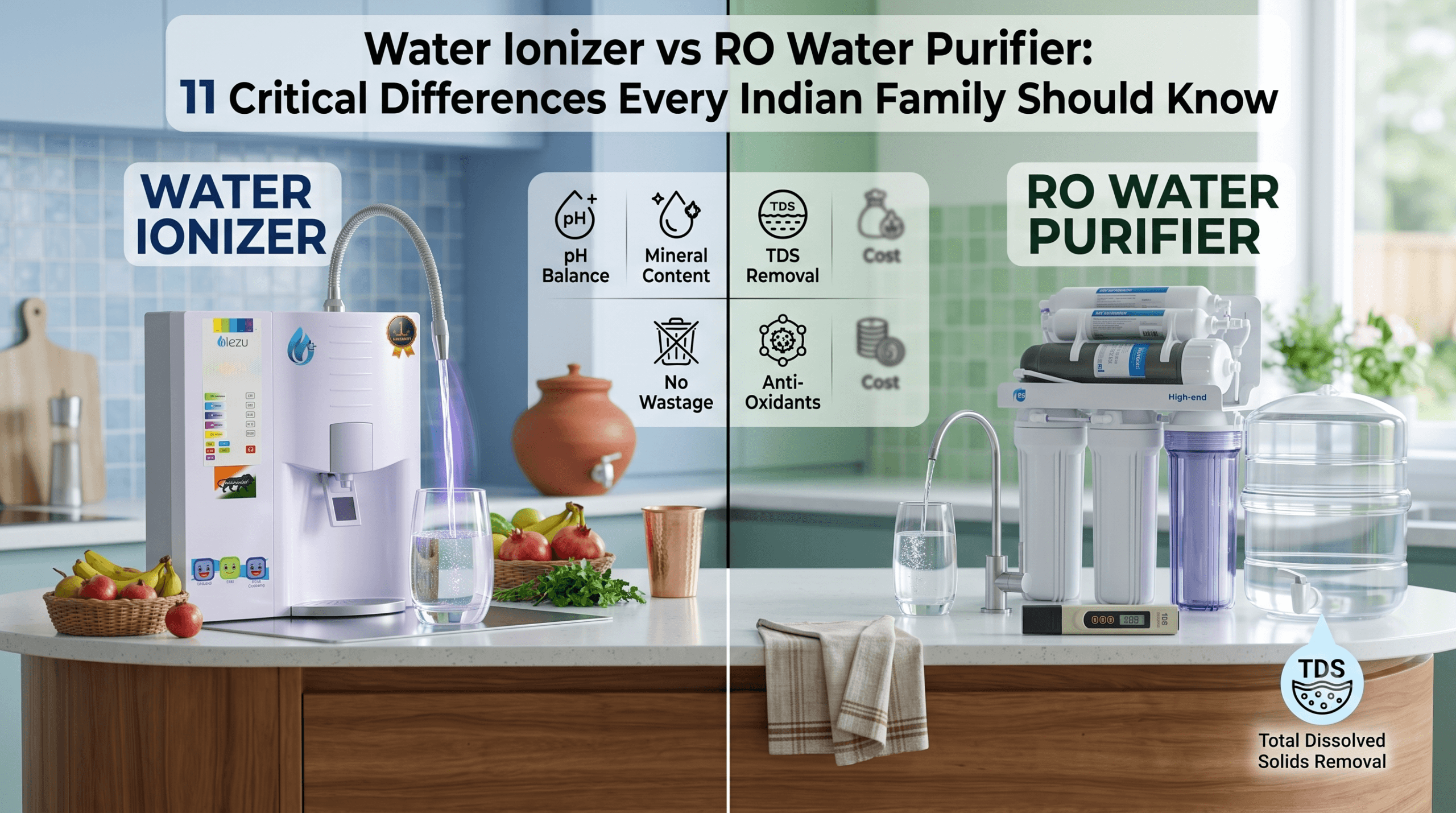

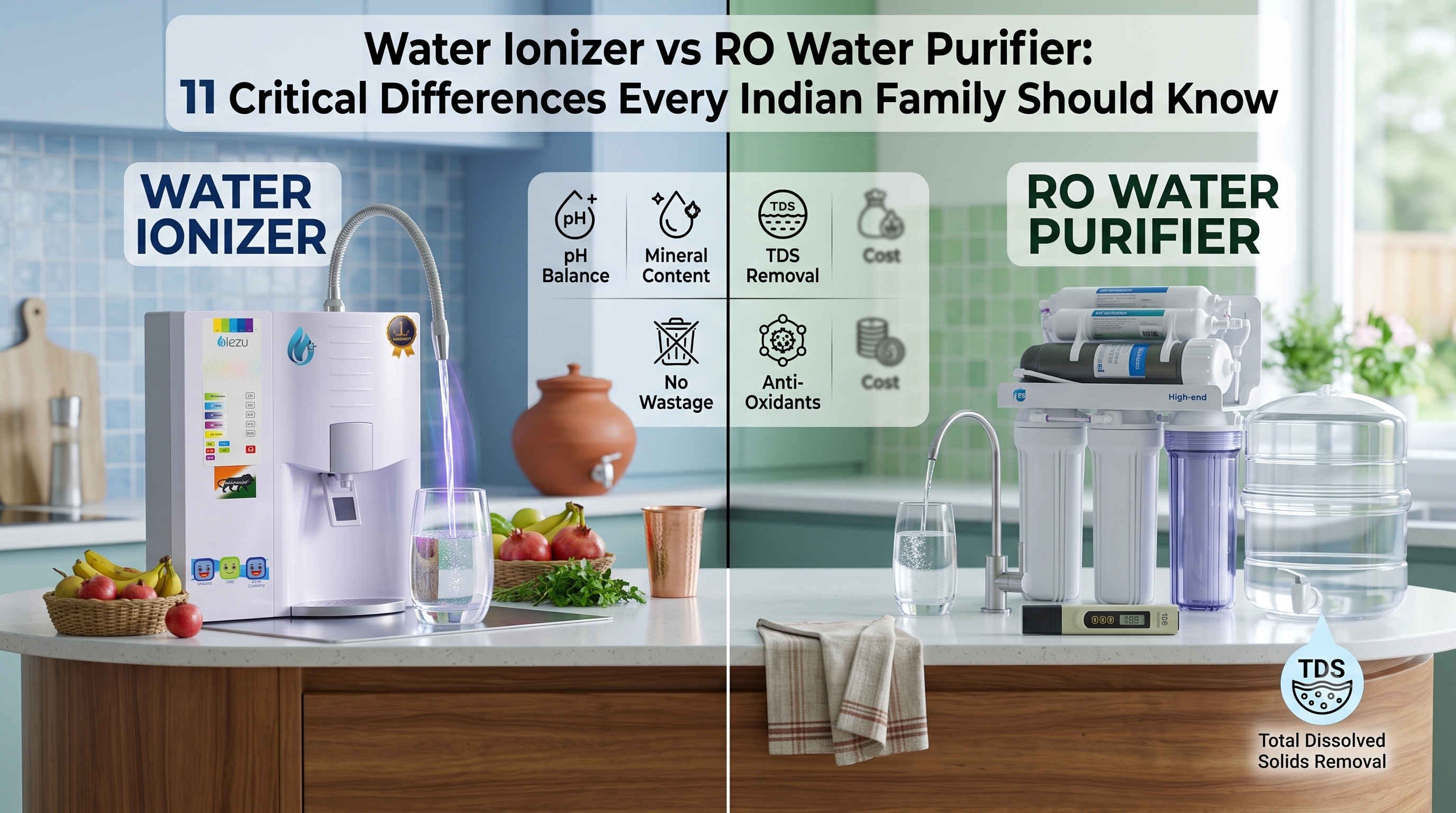
Choosing a water purification system has become more complicated than ever before.
A decade ago, the decision was relatively simple. Most homeowners purchased an RO water purifier because it was widely considered the best solution for drinking water.
Today, the market has evolved.
As more Indian households look beyond basic water purification, many are comparing conventional RO water purifiers with modern water ionizers. This growing interest reflects a shift toward solutions that not only purify water but also offer features such as adjustable pH and multiple water modes. However, these technologies are designed to serve different purposes, making it important to understand how they compare before deciding which system is right for your home.
Should I buy a Water Ionizer or an RO Water Purifier?
The answer is not as straightforward as choosing one technology over another.
A water ionizer and an RO purifier are designed to solve different problems.
An RO purifier focuses primarily on removing contaminants from water.
A water ionizer focuses on producing alkaline water after purification. Some models also include integrated RO technology, allowing them to both purify and ionize water in a single system.
Understanding these differences is essential before investing in a water treatment system for your home.
This comprehensive guide compares water ionizers and RO water purifiers across technology, purification, water quality, maintenance, operating costs, suitability for Indian water conditions, and long term value.
Expert Insight
One of the most common misconceptions is that a water ionizer and an RO water purifier are competing technologies. In reality, they are designed to perform different functions. An RO system is primarily intended to reduce contaminants and dissolved solids from water, while a water ionizer is designed to produce alkaline water through electrolysis after the water has been properly filtered. In many Indian homes, particularly those with high-TDS water, these technologies are used together in integrated systems rather than as alternatives. Understanding your water source and purification requirements is the first step in choosing the right solution.
What Is an RO Water Purifier?
Reverse Osmosis, commonly known as RO, is one of the most widely used water purification technologies in India.
RO systems force water through a semi permeable membrane that removes:
- Dissolved salts
- Heavy metals
- Excess minerals
- Certain chemicals
- Various contaminants
RO purification is particularly useful where water has:
- High TDS
- Borewell supply
- Hard water
- Elevated mineral content
The primary objective of an RO purifier is water purification.
What Is a Water Ionizer?
A water ionizer is an advanced water treatment system that uses electrolysis after filtration.
Instead of only removing contaminants, the machine also separates purified water into:
- Alkaline water
- Acidic water
Premium water ionizers may also generate dissolved molecular hydrogen during electrolysis.
Depending on the model, water ionizers may operate:
- With pre filtered municipal water
- With external RO systems
- With integrated RO technology
Their primary objective is to improve the drinking water experience after purification.
Difference #1: Purpose
RO Water Purifier
Designed primarily for purification.
Its main goal is to remove contaminants from drinking water.
Water Ionizer
Designed to produce alkaline water after purification through electrolysis.
Many premium systems combine purification and ionization into one appliance.
This represents the biggest functional difference between the two technologies.
Difference #2: Technology
RO Technology
RO uses:
- High pressure
- Semi permeable membrane
- Multi stage filtration
The membrane removes dissolved solids from water.
Water Ionizer Technology
Water ionizers use:
- Electrolysis
- Titanium plates
- Platinum coating
- Electrical current
The electrolysis process changes certain characteristics of purified water while producing alkaline and acidic streams.
Difference #3: Water Quality
RO systems focus on producing purified water.
Water ionizers focus on producing purified alkaline water.
Premium ionizers equipped with integrated RO technology combine both purification and ionization within the same appliance.
This makes them suitable for areas where both high TDS purification and alkaline water production are required.
Several manufacturers now offer integrated RO water ionizers that combine purification and ionization in a single appliance. These systems are particularly suitable for Indian households with higher-TDS water, where both effective purification and alkaline water production are desired. Miezu’s integrated RO water ionizers follow this approach by combining reverse osmosis purification with electrolysis in one system, eliminating the need for separate appliances.
Difference #4: Mineral Content
One of the biggest discussion points involves minerals.
RO purification removes dissolved solids from water.
Many modern RO systems incorporate mineral cartridges or remineralization stages to improve the taste of purified water after treatment. The specific approach varies by manufacturer.
Water ionizers generally operate with water containing suitable mineral content because minerals play an important role during electrolysis.
Different manufacturers use different approaches for mineral management.
Difference #5: Suitable Water Sources
RO Purifiers
Generally recommended for:
- High TDS water
- Borewell water
- Hard water
Water Ionizers
Generally recommended for:
- Municipal water
- Filtered water
- Appropriate TDS ranges
Premium water ionizers equipped with integrated RO technology combine both purification and ionization within a single appliance. These systems are particularly suitable for homes with high-TDS water that require both purification and alkaline water production. They are also a practical choice for homeowners who prefer a single integrated unit instead of installing separate RO and water ionizer systems, or where available kitchen space is limited.
Understanding your water source is essential before choosing either system.
Difference #6: pH Control
Traditional RO systems do not provide adjustable pH settings.
Water ionizers allow users to produce water at different pH levels depending on the available settings and intended applications.
This feature distinguishes ionizers from conventional purification systems.
Difference #7: Multiple Water Types
A conventional RO purifier generally produces one type of purified drinking water.
Water ionizers may produce:
- Drinking water
- Mild alkaline water
- Higher alkaline water
- Acidic water for non drinking household applications
The available options depend on the specific model.
Difference #8: Maintenance Requirements
Both systems require routine maintenance.
RO Maintenance
Typical maintenance includes:
- Sediment filter replacement
- Carbon filter replacement
- Membrane replacement
- Periodic servicing
Water Ionizer Maintenance
Typical maintenance includes:
- Filter replacement
- Plate chamber inspection
- System servicing
- Descaling where required
Integrated RO ionizers require maintenance for both purification and ionization components.
Difference #9: Water Recovery
Traditional RO systems generate reject water during purification.
Recovery rates vary depending on:
- Membrane design
- Water quality
- Manufacturer
Water recovery efficiency varies by membrane design, feed water quality, operating pressure, and manufacturer specifications. Modern systems generally achieve higher recovery rates than earlier designs, although reject water generation remains a characteristic of RO technology.
Water ionizers without RO do not generate reject water through electrolysis itself.
Integrated RO ionizers follow similar recovery principles as other RO based systems.
Difference #10: Installation and Compatibility
RO systems generally require:
- Water inlet
- Drain connection
- Electricity
Water ionizers may require:
- Treated water supply
- Appropriate pressure
- Electrical connection
Integrated RO ionizers combine the installation requirements of both technologies.
Professional installation is recommended for either system.
Difference #11: Long Term Ownership
When evaluating long term ownership, buyers should consider:
- Purchase price
- Filter costs
- Annual maintenance
- Service availability
- Water compatibility
- Expected lifespan
The lowest purchase price does not always provide the lowest lifetime ownership cost.
Evaluating total cost of ownership provides a more accurate comparison.
Water Ionizer vs RO Water Purifier Comparison Table
| Feature | Water Ionizer | RO Water Purifier |
|---|---|---|
| Primary Purpose | Produces alkaline water after appropriate filtration through electrolysis | Purifies water by reducing contaminants and dissolved solids |
| Purification Technology | Filtration + Electrolysis (varies by model) | Reverse Osmosis (RO) + Multi-stage Filtration |
| Electrolysis | Yes | No |
| Adjustable pH Levels | Yes | No |
| Multiple Water Types | Yes (alkaline, neutral, acidic, depending on model) | No (drinking water only) |
| RO Filtration | Available in integrated RO water ionizer models | Standard feature |
| Suitable for High-TDS Water | Integrated RO models | Yes |
| Electrode Plate Technology | Titanium plates with platinum coating | Not Applicable |
| Hydrogen Generation | Available in some premium models | No |
| Water Purification | Yes, depending on the filtration system and model | Yes |
| Water Recovery | No reject water from ionization itself; depends on purification method | Reject water generated during RO purification |
| Installation | Requires treated water or integrated RO model, depending on the system | Requires water inlet, drain connection, and electricity |
| Space Requirement | Standard models may require an existing purifier if purification is needed; integrated RO models combine purification and ionization in one appliance, making them ideal where space is limited | Single appliance for purification |
| Maintenance | Filter replacement, electrolysis chamber maintenance, periodic servicing | Filter replacement, membrane replacement, periodic servicing |
| Electricity Requirement | Yes | Yes |
| Household Applications | Drinking water plus additional water modes for household uses (depending on model) | Drinking water |
| Best Suited For | Homes seeking alkaline water after appropriate purification | Homes primarily requiring water purification |
Which One Is Better for Municipal Water?
For municipal water with moderate TDS, many households choose:
- Standard water ionizers
- UV based systems
- UF systems
The ideal choice depends on the actual water quality and purification requirements.
Which One Is Better for Borewell Water?
High TDS borewell water generally requires RO purification.
Integrated RO water ionizers are specifically designed for this type of application because they combine purification with ionization.
Can You Use Both Technologies Together?
Yes.
Many premium water ionizers include integrated RO purification.
These systems first purify water and then perform electrolysis.
This approach combines the strengths of both technologies in a single appliance.
Which System Is Right for Your Home?
| If your home has… | Recommended |
|---|---|
| Municipal water with moderate TDS | Water Ionizer (where water quality is suitable) |
| Existing RO purifier | Post-RO Water Ionizer |
| Hard water or High-TDS borewell water | RO-based purification, with ionization if desired |
| Limited kitchen space or prefer a single appliance | Integrated RO Water Ionizer |
| Uncertain water quality | Water testing before selecting any system |
Example Scenarios
Scenario 1
A family in Delhi receives treated municipal water with moderate TDS.
A standard water ionizer may be suitable, provided the incoming water quality meets the manufacturer’s recommended specifications.
Scenario 2
A household in Punjab relies on borewell water with high TDS.
An integrated RO water ionizer can provide both purification and ionization within a single appliance.
Scenario 3
A homeowner already has an RO purifier installed.
Adding a post-RO water ionizer allows ionization without replacing the existing purification system.
Common Myths
Myth 1
A water ionizer replaces water purification.
Reality:
Ionization should always be performed after proper purification.
Myth 2
Every home needs an RO purifier.
Reality:
Water treatment should always match the local water source.
Myth 3
RO and water ionizers are competing technologies.
Reality:
Many premium systems combine both technologies.
Who Should Choose an RO Water Purifier?
An RO purifier may be appropriate for households that primarily require:
- High TDS reduction
- Borewell water purification
- Hard water treatment
Who Should Choose a Water Ionizer?
A water ionizer may be appropriate for homeowners interested in:
- Alkaline water
- Advanced hydration technologies
- Multiple water modes
- Premium home wellness appliances
The correct choice depends on water quality and household needs.
What to Look for When Choosing a Water Ionizer?
Choosing a water ionizer involves more than comparing features or price. The right system should match your home’s water quality, provide reliable long-term performance, and be backed by dependable service. Before making a purchase, consider the following factors:
Water Source Compatibility
Ensure the system is suitable for your primary water source. Homes with high-TDS borewell water typically require an integrated RO water ionizer, while homes with treated municipal water may be able to use a standard water ionizer, depending on water quality.
Integrated RO Availability
If your home requires both purification and ionization, consider a system that combines reverse osmosis and electrolysis in a single appliance. This simplifies installation and eliminates the need for separate systems.
Electrode Plate Quality
Look for durable electrode plates made from titanium with platinum coating. The quality of the electrolysis chamber plays an important role in the long-term performance and efficiency of the ionization process.
Filter and Maintenance Support
Check how frequently filters need replacement, whether spare parts are readily available, and if the manufacturer offers reliable after-sales service in your area.
Warranty Coverage
Compare warranty terms for major components such as the electrolysis chamber, filters, and electronic parts. A comprehensive warranty can reduce long-term ownership costs.
Certifications and Manufacturing Standards
Consider products manufactured under recognised quality standards and supported by transparent technical documentation. Certifications and quality management systems can provide additional confidence in product reliability.
Local Service Network
A manufacturer with an established service network can make routine maintenance, filter replacement, and technical support more convenient throughout the product’s lifespan.
The best water ionizer is not necessarily the one with the longest feature list, it is the one that matches your home’s water quality, is supported by reliable after-sales service, and is built to perform consistently over the long term. For Indian households, choosing a manufacturer that designs systems for local water conditions and provides nationwide service can make a significant difference in both performance and ownership experience.
External Resource
For comprehensive information on household drinking water treatment technologies, refer to the World Health Organization Guidelines for Drinking Water Quality.
WHO Guidelines for Drinking Water Quality
Frequently Asked Questions
Is a water ionizer better than an RO water purifier?
Neither is universally better. RO water purifiers focus on removing contaminants, while water ionizers produce alkaline water after appropriate filtration. Integrated systems combine both functions for households that require purification and ionization.
Can a water ionizer replace an RO purifier?
Only if the incoming water quality is already suitable. Homes with high TDS water often require RO purification before ionization.
Can a water ionizer and RO work together?
Yes. Many premium systems combine RO purification and water ionization in a single appliance.
Does a water ionizer remove contaminants?
Water ionizers rely on their filtration system for purification. The ionization process itself is designed to modify the characteristics of already purified water.
Which system is better for borewell water?
Homes with high TDS borewell water generally require RO based purification. Integrated RO water ionizers are designed for these conditions.
Which system requires more maintenance?
Both systems require periodic filter replacement and servicing. Maintenance requirements depend on water quality, usage, and system design.
Conclusion
The debate between a water ionizer and an RO water purifier is often based on the misconception that they perform the same job.
They do not.
An RO purifier is designed primarily to remove contaminants and reduce dissolved solids.
A water ionizer is designed to produce alkaline water after purification through electrolysis. Many premium models also integrate RO purification, combining both technologies into a single system.
Rather than asking which technology is better, homeowners should ask which technology best matches their water quality, lifestyle, and long term health goals.
Making that distinction will help you choose a system that delivers reliable performance, appropriate purification, and a better overall drinking water experience for years to come.